FDA Facility Renewal Is Coming: What Every Food Importer Needs to Know Before End of 2026
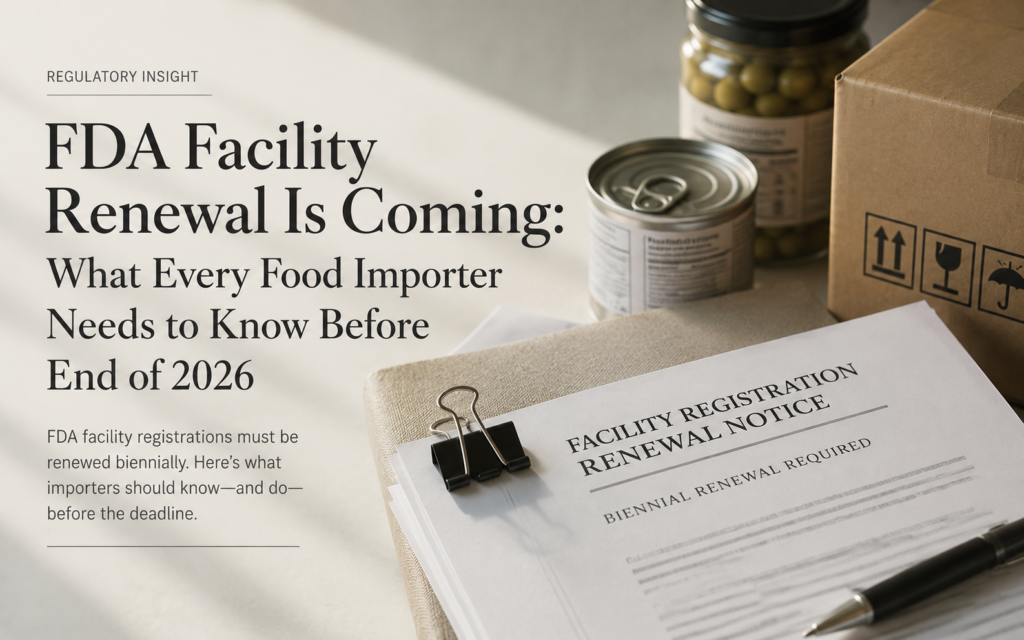
Every two years, a quiet deadline arrives that can stop a food import business in its tracks — and 2026 is one of those years. From October 1 through December 31, 2026, every food facility registered with the FDA must renew that registration. Miss the window, and the consequences are immediate and unforgiving. As someone who works with Japanese exporters and US importers every day, I can tell you the businesses that treat this as a routine check-in sail through it, and the ones that forget it lose their access to the US market at the worst possible time — the fourth-quarter holiday season
Here is what you need to know, and what to do now.
The Rule, in Plain Terms
The FDA requires every facility that manufactures, processes, packs, or holds food for US consumption — domestic and foreign alike — to renew its registration every even-numbered year, during a fixed window: October 1 to December 31. This is not optional, and it is not triggered by any change on your end. Even if nothing about your facility has changed since 2024, you still must renew. Think of it as a mandatory compliance heartbeat: the FDA confirming, every two years, that it knows exactly who you are and where you are.
There is no fee to renew. And, importantly, you cannot renew early — the portal only accepts renewals once the window opens on October 1.
Why the Deadline Is So Dangerous
This is where importers get hurt. If you do not renew by December 31, 2026, the FDA does not send a warning or offer a grace period. Your registration simply expires. The moment it does, your facility is no longer registered — and food from an unregistered foreign facility cannot lawfully enter the United States. Shipments are subject to refusal at the port.
For an importer, that means product stranded at the border, demurrage charges piling up, empty shelves during peak season, and an emergency scramble to re-register while inventory sits in limbo. A five-minute administrative task, skipped, becomes a five-figure problem. The timing makes it worse: the deadline lands at the end of Q4, exactly when holiday and New Year inventory is moving.
The Two Things That Trip Foreign Facilities Up
For Japanese producers and other foreign exporters, two requirements cause the most trouble every cycle.
The Unique Facility Identifier (DUNS number). The FDA will not confirm a registration or renewal without a valid Unique Facility Identifier, and the identifier it currently recognizes is the DUNS number issued by Dun & Bradstreet. The FDA verifies that the facility name and address on your registration match the DUNS record exactly. If your DUNS is missing, expired, or shows a different address than your registration, the renewal will not go through — and sorting out a DUNS mismatch with D&B can take weeks. This is the single most common reason a foreign renewal stalls, so it is the first thing to check.
The US Agent. Every foreign food facility must designate a US Agent — a party physically located in the United States who serves as the facility’s point of contact with the FDA. Your registration cannot be completed or renewed without a valid US Agent on file, and that agent must have agreed to serve. If your US Agent arrangement has lapsed, if the agent has changed, or if their contact details are out of date, the renewal will fail. Confirming your US Agent is current — and that they are ready to act during the renewal window — is not a formality; it is a prerequisite.
Renewal Is Also Your Best Chance to Clean House
Smart importers treat the renewal not just as a box to check but as a scheduled audit of their FDA records. The renewal window is the natural moment to review and correct everything the FDA has on file: your facility address, contact names and emails, ownership or management changes, and — critically — your food product categories. If you have added product lines since your last renewal, or changed what a facility handles, this is when to make the registration accurate. Errors as small as an outdated email or a misspelled address can create compliance headaches down the line, and this is your no-cost opportunity to fix them.
A Practical Timeline for 2026
Start before October. Use the weeks ahead of the window to verify your DUNS number matches your facility details and to confirm your US Agent is in place and reachable. Gather your FDA Industry Systems (FIS) login credentials now — a surprising number of renewals stall simply because no one remembers who holds the account.
When the window opens October 1, renew early rather than late. Submitting in October leaves room to resolve any DUNS or UFI verification issues before the hard December 31 cutoff. If a problem surfaces — a mismatched address, a lapsed agent — you want weeks of runway, not days.
And remember that registration is separate from Prior Notice: even a perfectly renewed facility must still file Prior Notice for every individual shipment. Renewal keeps the door open; Prior Notice gets each shipment through it.
The Bottom Line
The end-of-2026 FDA facility renewal is a small task with outsized stakes. For US importers and the Japanese suppliers they depend on, an expired registration is not a paperwork inconvenience — it is a closed border during your busiest quarter. Verify your DUNS, confirm your US Agent, log into your FIS account, and renew in October. The businesses that prepare now will never feel the deadline. The ones that wait may spend January explaining to customers why the shelves are empty.
This column is for general information only and does not constitute legal or regulatory advice. FDA registration requirements are set by federal regulation and may change; confirm current requirements at fda.gov or with a qualified compliance professional.