Deep into Matcha Part 1: What Is Ceremonial? What Is Culinary?
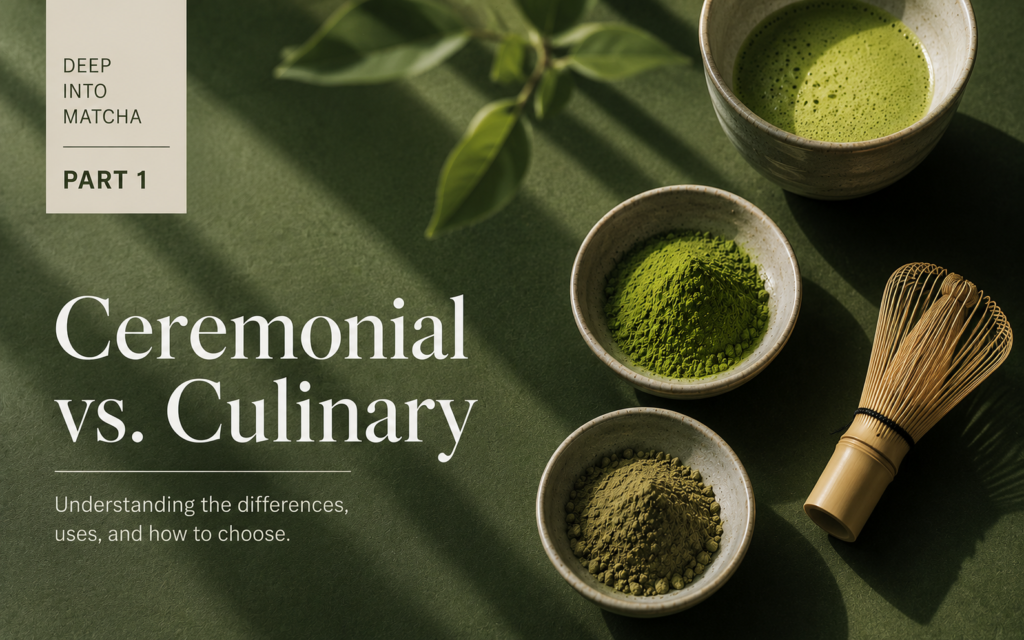
Walk down any tea aisle or scroll any online shop and you will see the same two words attached to matcha: ceremonial and culinary. They sound official, almost regulated — as if a governing body somewhere stamps each tin. The truth is more interesting, and understanding it is the first real step to buying matcha well. Welcome to Part 1 of Deep into Matcha, where we start at the foundation: what these grades actually mean, why they exist, and how to choose between them.
First, a Myth to Retire
There is no official, legally defined matcha grading system. “Ceremonial” and “culinary” are not certifications handed down by a Japanese authority. They are descriptive terms — a shorthand the market uses to signal quality and intended use. That does not make them meaningless; a reputable producer uses them consistently and honestly. But it does mean the words alone are not a guarantee. What sits behind the label — the leaves, the shading, the harvest, the grinding — is what actually determines quality. So let’s look at what really separates a ceremonial matcha from a culinary one.
It Starts in the Field: Shading
All true matcha begins with tencha — tea leaves that have been shade-grown before harvest. In the weeks leading up to picking, the tea plants are covered to block most of the sunlight. Deprived of direct sun, the leaves respond by producing more chlorophyll (giving matcha its vivid green) and more L-theanine, the amino acid responsible for matcha’s savory sweetness and calm, focused energy.
Higher grades generally come from leaves that are shaded longer and more carefully. More shading means more L-theanine, deeper color, and a smoother, less astringent cup. This is the first fork in the road between ceremonial and culinary quality — and it happens weeks before anyone touches a grinding stone.
The Harvest: First Flush vs. Later Pickings
Timing matters enormously. The first flush — the season’s earliest harvest, in spring — yields the youngest, most tender leaves at the top of the plant. These leaves are naturally sweeter, greener, and lower in the bitter compounds that develop with age and sun exposure. First-flush leaves are the backbone of ceremonial-grade matcha.
Later harvests, taken from more mature leaves lower on the plant across the growing season, produce a matcha that is more robust, more astringent, and often more affordable. These leaves make excellent culinary matcha — where a stronger, more assertive flavor is actually an advantage.
Ceremonial Grade: Made to Drink on Its Own
Ceremonial matcha is the top tier, made to be enjoyed the simplest way possible: whisked with nothing but hot water and sipped on its own. Everything about it is optimized for that pure experience.
Expect a vibrant, almost electric jade green — a sign of high chlorophyll and careful shading. The flavor is smooth and rounded, with natural sweetness, a savory umami depth, and little to no bitterness. The texture is fine and silky, because the best leaves are stone-ground slowly into an ultra-fine powder. When you whisk it, it froths into a smooth, creamy layer rather than a gritty one.
Because ceremonial matcha is delicate, it is meant to be tasted, not buried. Adding it to a sweet, milky drink would mask the very qualities you paid for. Use it when matcha is the star: a traditional bowl (usucha), or a simple, high-quality shot you actually want to taste.
Culinary Grade: Built to Perform in a Recipe
Culinary matcha is not “lower quality” in a pejorative sense — it is purpose-built for a different job. It comes from more mature leaves and later harvests, giving it a bolder, stronger, more bitter-forward flavor and a slightly less vivid green.
That strength is the point. When matcha goes into a latte, a smoothie, ice cream, baked goods, or a sweetened drink, it has to stand up to milk, sugar, and other ingredients. A delicate ceremonial matcha would simply disappear; a robust culinary matcha cuts through and keeps that distinct matcha flavor present. Culinary grade is also more affordable, which makes it the sensible choice for anything you are mixing, cooking, or making in volume.
There are also sub-tiers within culinary matcha — often labeled things like “premium,” “café,” or “ingredient” grade — designed for specific uses like latte bars versus baking. The naming varies by producer, which brings us back to the central lesson.
So Which Should You Buy?
The honest answer: it depends entirely on what you are going to do with it.
If you want to drink matcha on its own — a morning bowl, a moment of ritual, a pure shot — buy ceremonial. You are paying for the smoothness, sweetness, and color, and you will taste every bit of it. If you are making lattes, smoothies, desserts, or anything sweetened or blended, buy culinary. It performs better in the recipe and costs less, and no one will miss the subtlety that milk and sugar would have covered anyway.
A useful test: Would I drink this with just hot water and enjoy it? If yes, you want ceremonial. If it’s going into something else, culinary is the smarter — and more economical — choice.
What the Label Can’t Tell You
Here is the thread running through everything above: the words “ceremonial” and “culinary” describe intent and quality, but they are only as trustworthy as the producer using them. Two tins both marked “ceremonial” can be worlds apart, because the terms are unregulated. What you are really buying is the shading, the harvest timing, the region, and the care of the farmer who made it.
That is exactly why sourcing matters — and why knowing who grew your matcha is the most reliable quality signal of all. In Part 2 of Deep into Matcha, we’ll go further into the field: origin and region, what “first flush” really means for flavor, and how to read a matcha’s color, aroma, and froth like a professional.
Connect Directly With Japanese Matcha Farmers
The best way to know what’s really in your matcha is to know the people who grow it. Studio 1414 connects US buyers, cafés, and brands directly with Japanese matcha farmers — authentic, traceable, producer-direct sourcing with no guesswork.
➡️ Connect with Japanese matcha farmers: https://1414usa.com/lp/connect-matcha/
Deep into Matcha is an educational series by Studio 1414 LLC, a Los Angeles-based importer specializing in premium Japanese food products and producer-direct sourcing. Stay tuned for Part 2.