Deep into Matcha Part 2: Stone-Mill vs. Ball Mill
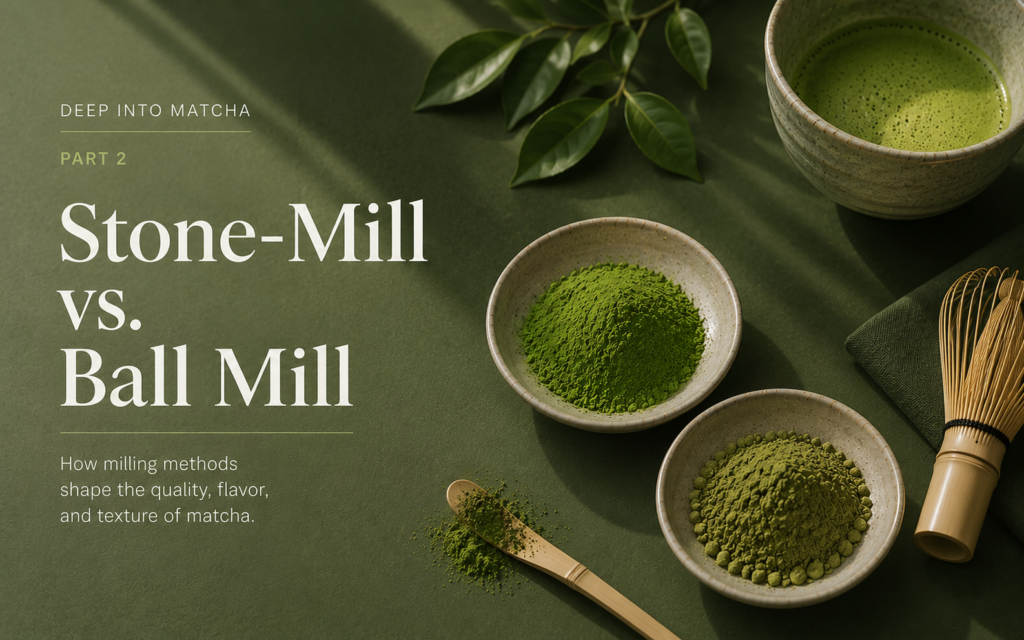
In Part 1, we cleared up the ceremonial-versus-culinary confusion and traced quality back to the field — the shading, the harvest, the leaf. But there is one more step that transforms shade-grown tea leaves into the fine green powder in your bowl, and it is one most buyers never think about: how the leaf is ground. Welcome to Part 2 of Deep into Matcha, where we get into the machinery. Because whether your matcha was made on a slow granite stone mill or a fast ceramic ball mill changes the taste, texture, and even the color of what you drink.
From Leaf to Powder: Why Grinding Is Its Own Art
By the time tea leaves are ready to become matcha, they have already been shade-grown, steamed, dried, and de-veined into a crumbly leaf called tencha. That tencha then has to be reduced to a powder so fine it feels like talc between your fingers — fine enough to suspend in water rather than sink. Matcha’s signature smooth mouthfeel, its ability to froth, and even how its flavor unfolds all depend on how small and how uniform those particles are.
There are two ways to get there: the traditional stone mill, and the modern ball mill. They produce genuinely different results.
The Stone Mill: Slow, Cool, and Traditional
The traditional method uses a ishi-usu — a granite stone mill, two carved discs turning against each other. Tencha is fed into the center, and as the top stone slowly rotates, the leaf is crushed and drawn outward, emerging at the edges as fine powder.
The defining feature of the stone mill is that it is slow. A single granite mill produces only a small amount of matcha per hour — often around 30 to 40 grams. That is not a flaw; it is the point. The slow rotation keeps friction low, which keeps the powder cool. Heat is matcha’s enemy: it degrades the delicate aromatic compounds, dulls the vivid green, and can introduce a scorched, flattened flavor. By grinding slowly and cool, the stone mill preserves the aroma, color, and nuanced sweetness that define the highest-quality matcha.
The particles a stone mill produces are extremely fine and irregularly shaped. Counterintuitively, that irregularity is desirable — those flat, plate-like particles are part of what gives stone-ground matcha its silky texture and rich, foamy froth when whisked.
The trade-off is obvious: time and cost. Stone milling is slow, labor-intensive, and cannot easily scale. This is why true stone-ground ceremonial matcha commands a premium — you are paying for the hours the stone took.
The Ball Mill: Fast, Efficient, and Modern
A ball mill takes a different approach entirely. Tencha is placed in a rotating drum along with ceramic balls or beads; as the drum spins, the tumbling balls pulverize the leaf into powder. It is fast, high-volume, and far cheaper per gram than stone milling — a ball mill can produce in minutes what a stone mill makes in an hour.
For culinary matcha and large-scale production, this is a perfectly sensible choice. When matcha is destined for lattes, smoothies, baking, or ice cream, the speed and economy of ball milling make it the practical option, and the results are more than good enough for a drink that will be sweetened and blended anyway.
But ball milling has trade-offs. The high-energy tumbling generates more friction and heat, which can subtly affect the aroma and color of the finished powder. Ball-milled particles also tend to be more uniform and rounded — efficient, but without quite the same silky texture and froth-building character of stone-ground powder. For a matcha you intend to sip on its own, those differences are noticeable.
Does the Difference Actually Reach Your Cup?
Yes — but how much you notice depends on how you drink it.
If you are whisking matcha with hot water and drinking it straight, the grinding method matters a great deal. Stone-ground matcha tends to taste smoother and rounder, froths more richly, and holds a brighter color and fuller aroma. Side by side in a plain bowl, a trained palate can tell the difference.
If you are making a sweetened matcha latte or folding matcha into a dessert, the gap narrows sharply. Milk, sugar, and heat flatten the very subtleties that stone milling protects, so paying a stone-mill premium for a drink you are going to sweeten is often money spent where you cannot taste it.
In other words, the grinding method should match the mission. Stone-ground for pure drinking; ball-milled culinary for mixing and cooking. Neither is “better” in the absolute — they are optimized for different cups.
A Buyer’s Reality Check
Here is where it gets tricky, and where Part 1’s lesson returns. “Stone-ground” is a powerful marketing phrase, and like “ceremonial,” it is not tightly regulated. Some products labeled stone-ground are only partially so, or use the phrase loosely. The grind is also only one variable — a stone-milled matcha made from poor, over-sunned leaves will still taste worse than a well-made culinary grade. Grinding method amplifies leaf quality; it cannot rescue bad leaf.
So the smart questions to ask are layered: What leaf went in (shading, harvest, region)? How was it ground, and by whom? A producer who can answer both clearly is one worth trusting.
Coming Up in Part 3
We have now followed matcha from the shaded field (Part 1) through the grinding stone (Part 2). In Part 3 of Deep into Matcha, we’ll put it all to use: how to evaluate a matcha with your own senses — reading its color, aroma, texture, and froth — so you can judge quality for yourself, no label required.
Connect Directly With Japanese Matcha Farmers
The surest way to know how your matcha was grown and ground is to know the farmer who made it. Studio 1414 connects US buyers, cafés, and brands directly with Japanese matcha farmers — authentic, traceable, producer-direct sourcing with no guesswork.
➡️ Connect with Japanese matcha farmers: https://1414usa.com/lp/connect-matcha/
Deep into Matcha is an educational series by Studio 1414 LLC, a Los Angeles-based importer specializing in premium Japanese food products and producer-direct sourcing. Missed Part 1? Start with “What Is Ceremonial? What Is Culinary?” — and stay tuned for Part 3.